25 Cost-Ranked Ways to Increase Restaurant Sales
 Ali Tanis18 min read
The fastest way to increase restaurant sales is to pull the levers you already own before you pay for new ones: what servers suggest, what your listings show and how often regulars hear from you. Below are 25 year-round tactics, ranked by cost to start, time to first result and who on your team owns the job.
Quick Summary: The cheapest way to increase restaurant sales is eight quick wins: an upsell script, online add-ons, bundles, a photo on every dish, a complete Google profile, review replies, cleaner prices and a direct-order bag card. Each costs under $100 and shows up within weeks. Ads, catering and retail come later.
How do you increase restaurant sales fastest?
For most restaurants, sales are customers times average check times visits per customer. The fastest gains come from the check and the conversion rate, because they need no new customers: a scripted add-on works on the next service, and a photo on a bare listing works the week it goes live. Traffic tactics take longer.
The National Restaurant Association's 2026 State of the Restaurant Industry report projects $1.55 trillion in sales but only 1.3% real growth, after a year when 60% of operators reported softer traffic. USDA's Food Price Outlook shows restaurant prices up 3.4% from August 2025 to August 2026.
So most growth on paper is price, not people. Yet most lists of ways to increase restaurant sales sort tactics by goal or by the vendor's own software, and none tells you what to do on Monday. The matrix below does.
The effort-vs-impact matrix: 25 ways to increase restaurant sales
Rank every way to increase restaurant sales by three things: what it costs to start, how soon the first result shows in your POS data, and who owns it. Eight tactics cost under $100 and pay back within a month, twelve compound over one to three months, and five need real cash or patience.
Costs and timings are our planning estimates for one independent restaurant, not industry averages. The lever column shows what moves: traffic, check size, visits or margin.
| # | Tactic | Lever | Cost to start | First result | Owner |
|---|---|---|---|---|---|
| 1 | Upsell script | Check | $0 | Next shift | FOH manager |
| 2 | Add-ons on online orders | Check | $0 | 1 week | GM |
| 3 | Bundles for two and four | Check | $0 | 1-2 weeks | Chef + GM |
| 4 | Photos on every dish | Conversion | $0-$45 | 1-2 weeks | GM |
| 5 | Full Google profile | Traffic | $0 | 2-4 weeks | Owner |
| 6 | Review replies and asks | Traffic | $0 | 2-4 weeks | GM |
| 7 | Numeral-only prices | Check | $0-$80 | Next reprint | Owner |
| 8 | Direct-order bag card | Margin | $50-$90 | 2-4 weeks | Owner |
| 9 | Menu engineering | Margin | $0 | 30-90 days | Owner + chef |
| 10 | Targeted price rises | Check | $0 | 1 month | Owner |
| 11 | Cut slow sellers | Margin | $0 | 2-4 weeks | Chef |
| 12 | Slow-night offer | Traffic | Discount only | 2-4 weeks | GM |
| 13 | Email and SMS list | Visits | $0-$50/mo | 1 month | Marketing lead |
| 14 | Loyalty program | Visits | $0-$150/mo | 1-3 months | Owner |
| 15 | Own online ordering | Margin | $0-$100/mo | 1 month | Owner |
| 16 | Delivery listing + welcome deal | Traffic | 15-30% commission | 1-2 weeks | GM |
| 17 | Gift cards all year | Cash | $0-$100 | 2-4 weeks | GM |
| 18 | Three dish posts a week | Traffic | $0 | 1-3 months | Marketing lead |
| 19 | Website with a text list | Traffic | $0-$500 | 1-3 months | Owner |
| 20 | Faster turns at peak | Covers | $0-$2,000 | 2-4 weeks | GM |
| 21 | Office catering trays | Big tickets | $200-$1,000 | 1-3 months | Owner + chef |
| 22 | Private events | Big tickets | $0-$500 | 1-3 months | Events lead |
| 23 | Paid local ads | Traffic | $150-$900/mo | 2-4 weeks | Marketing lead |
| 24 | Creator visits | Traffic | $100-$500 comps | 2-6 weeks | Owner |
| 25 | Retail products | New revenue | $500-$3,000 | 2-3 months | Owner |
Rows 1 to 8 are this month's work, rows 9 to 20 start in month one and pay out by month three, and rows 21 to 25 wait until the basics run themselves. Photos sit in the quick-win band because the delivery platforms measure them.
Quick wins: 8 strategies under $100 that pay back within weeks
Quick wins are the cheapest way to increase restaurant sales because they need no new customers. They raise the check or the share of browsers who buy. Run all eight in month one; most need one staff meeting and an afternoon in your listings.
1. Script three upsell moments
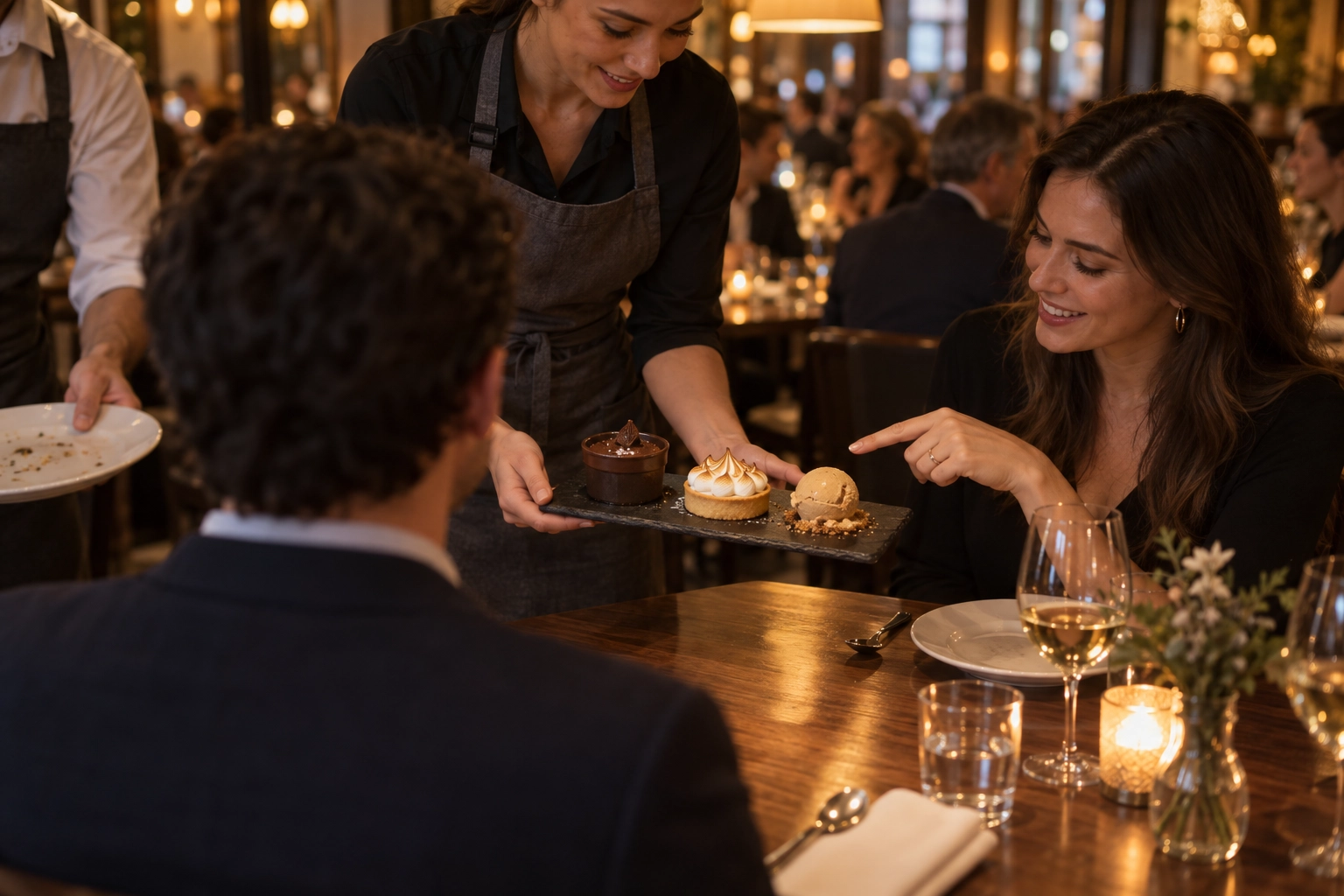 Server offering a dessert trio to two diners as dinner plates are cleared, a scripted upsell moment that lifts the check
Pick three moments and write one line for each: the drink when guests sit, the side when they order a main, dessert when plates clear. "The short rib is great with the charred broccolini" beats "anything else?" and improves the dining experience. A study in the Journal of Organizational Behavior Management found goal setting, feedback and praise raised servers' suggestions of cocktails, appetizers and desserts, with desserts rising most.
Do the arithmetic with your team: a $4 add-on on one check in four, across 2,000 checks a month, is $2,000 in extra revenue. Track each server's add-on rate weekly. For bars and lounges, script the second drink.
2. Add modifiers to every online order
Online, nobody suggests the fries unless the ordering page does. Add one modifier group to each best seller: extra protein, a side, a drink or a dessert. Add-ons boost the check from the first order. Our delivery sales fixes show where each app hides the setting.
3. Build bundles for two and four
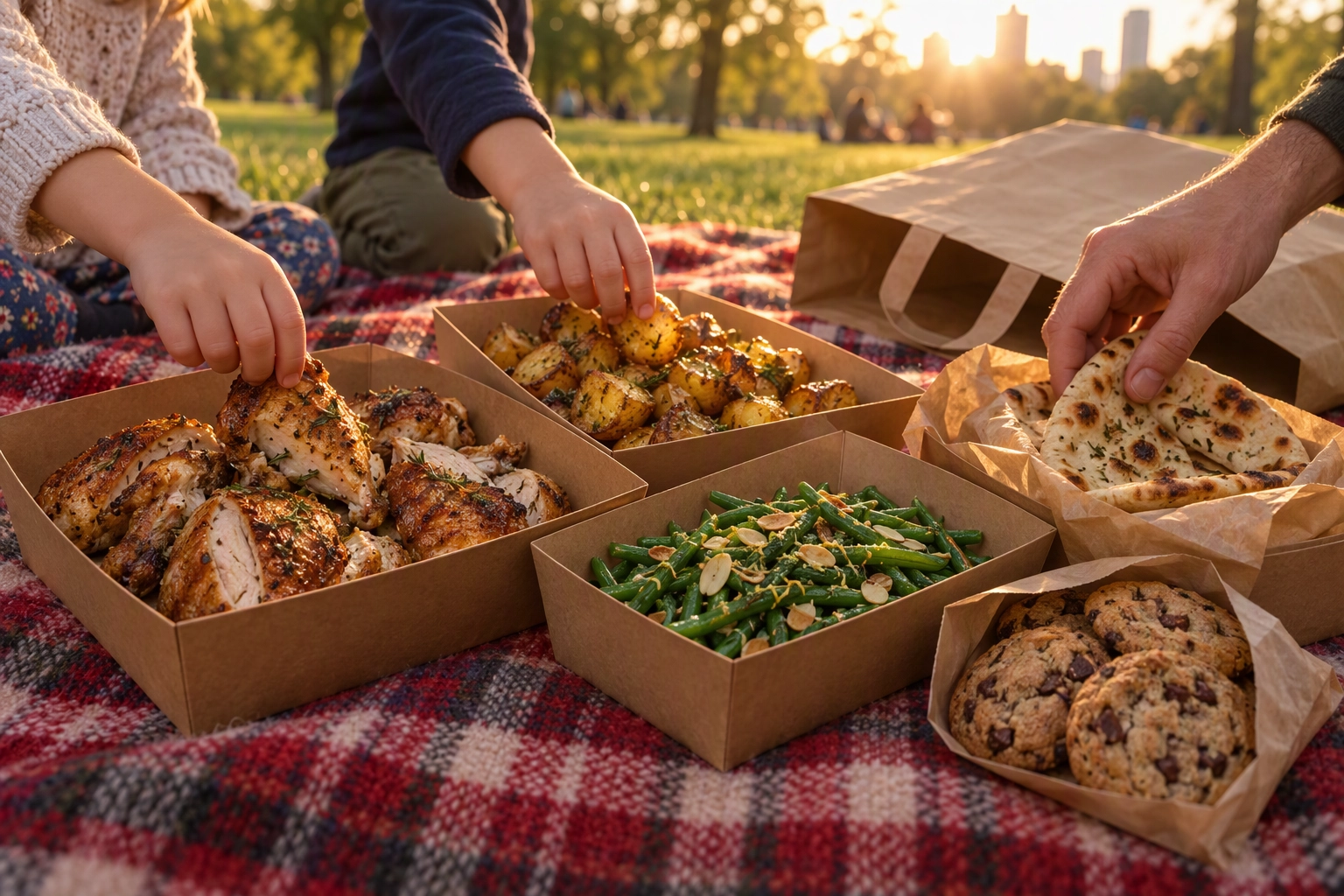 Family bundle for four from a restaurant opened on a park blanket: roast chicken, two sides, flatbreads and cookies
A $42 dinner for two (two mains, one shared starter, one dessert) sells the dessert you would otherwise lose. Price a bundle about 10% under the separate items so it reads as a deal, and create it from dishes that share prep. Bundles make better promotions than coupons, because the discount buys a bigger check. Cafes can pair coffee and pastry the same way.
4. Put a photo and a description on every dish
If you want to increase restaurant sales on delivery apps, photos are the cheapest lever, because the platforms measure them. DoorDash reports that menus with item photos see up to 44% more monthly sales, and descriptions up to 18% more. Uber Eats says merchants with photos and descriptions on at least 70% of items in their first week earned $330 more a week on average.
You don't need a shoot. Photograph each dish by a window (phone photo steps), write 15 to 20 words naming the protein, method and one flavour (menu descriptions has rewrites), and upload one set to the apps, your website and Google. If the snaps look flat, FoodShot's restaurant food photography restyles them into 2K images in about 2 minutes each, from $15 for 25 photos (pricing). See delivery app photos for Uber Eats and DoorDash listings, and avoid the photo mistakes that cost orders.
5. Complete your Google Business Profile
Your Google profile is the first list of dishes many new diners see. Fill every field: hours, a link to your list, order and booking buttons, and a photo for each category. Update it the day hours change, because wrong hours cost the visit and earn a one-star review. Our Google Business Profile playbook lists the photo slots; the photo specs page lists sizes.
6. Reply to reviews and ask at the right moment
Better reviews are one of the few ways to increase restaurant sales with academic evidence behind them. Harvard Business School's Michael Luca found that a one-star rise in a Yelp rating led to a 5% to 9% gain in revenue, driven by independent restaurants rather than chains. Reply to every review within two days and fix what the reply promises. Ask when the guest is happiest, as dessert lands or with a QR code on the receipt, and never attach a discount.
7. Drop the dollar signs and anchor your prices
In a Cornell field study at the Culinary Institute of America, guests whose menus showed plain numerals spent more than guests who saw dollar signs; the Cornell Chronicle put the gap at $5.55 a check, about 8%. Print 24, not $24.00. Put your priciest main at the top of each section so the dish below it reads as sensible. Layout rules: how to design a restaurant menu; the same applies to counter-service menu boards.
8. Put a direct-order card in every delivery bag
Every app order is a customer you paid a commission to meet. A $60 run of bag cards offering a small perk on the next direct order moves some of them to your own channel, where you keep more margin and the email address. Keep the perk honest and read your platform agreement before you print.
Steady builders: 12 strategies that compound over 1 to 3 months
Steady builders increase restaurant sales slowly but cost little, because they change habits: how often regulars return, which dishes customers pick and which channel they order through. Start them in month one so they pay out by month three, and give each one a named owner and a single number to watch.
9. Run menu engineering on 90 days of sales
Menu engineering ranks every dish by contribution margin and popularity, then gives each quadrant one move: protect stars, re-price plough-horses, promote puzzles, cut dogs. You need a spreadsheet and POS data, or a restaurant consultant if you'd rather not. Our menu engineering walkthrough runs it on a 30-item bistro list and finds $1,917 a month from three changes, one of them a single photograph.
10. Raise prices where customers won't notice
Across-the-board hikes invite comparison; targeted ones rarely do. Raise popular, low-margin dishes by $0.50 to $1.50, leave signatures alone, and never raise a price in the month you shrink a portion. With restaurant prices up 3.4% in a year, customers expect some movement. Price from plate cost, not from the place next door: our food cost calculator does the arithmetic.
11. Cut the dishes that don't sell
A shorter list cooks faster, wastes less and pushes guests toward the plates that pay. Cut anything selling under half its fair share for a quarter, unless it covers a dietary need or a regular's ritual. Need replacements? Restaurant menu ideas lists 45 menu items with typical cost percentages.
12. Give your slowest night a reason
Use discounts to boost slow nights, never full ones. Pick your two weakest shifts from POS data and give each a hook: a Tuesday burger-and-beer price, a Wednesday quiz, an early-bird set before 6 pm. In a June 2025 holdout test, Uber Eats found its offers drove 23% more orders and a 15% revenue lift even after discounts. More ideas: slow-night promotions.
13. Build an email and SMS list
Email is the cheapest channel to increase restaurant sales from people who already like you: you own the list, but only rent your followers. Capture addresses at booking, checkout and Wi-Fi login, then send one useful message a month: a new dish, a slow-night hook or upcoming events. Keep texts for urgent offers and get explicit opt-in first. Many restaurant marketing tools handle both, and our restaurant marketing ideas add 50 more campaigns.
14. Launch a loyalty program customers can actually reach
In the National Restaurant Association's 2024 technology report, 81% of consumers not yet in a loyalty program said they'd join one at a favorite restaurant. DoorDash's 2026 trends survey of 3,001 consumers found 66% order more often where they're active members. Make the first reward reachable within three or four visits, and let it work on every channel: dine-in, pickup and online.
15. Take online orders on your own website
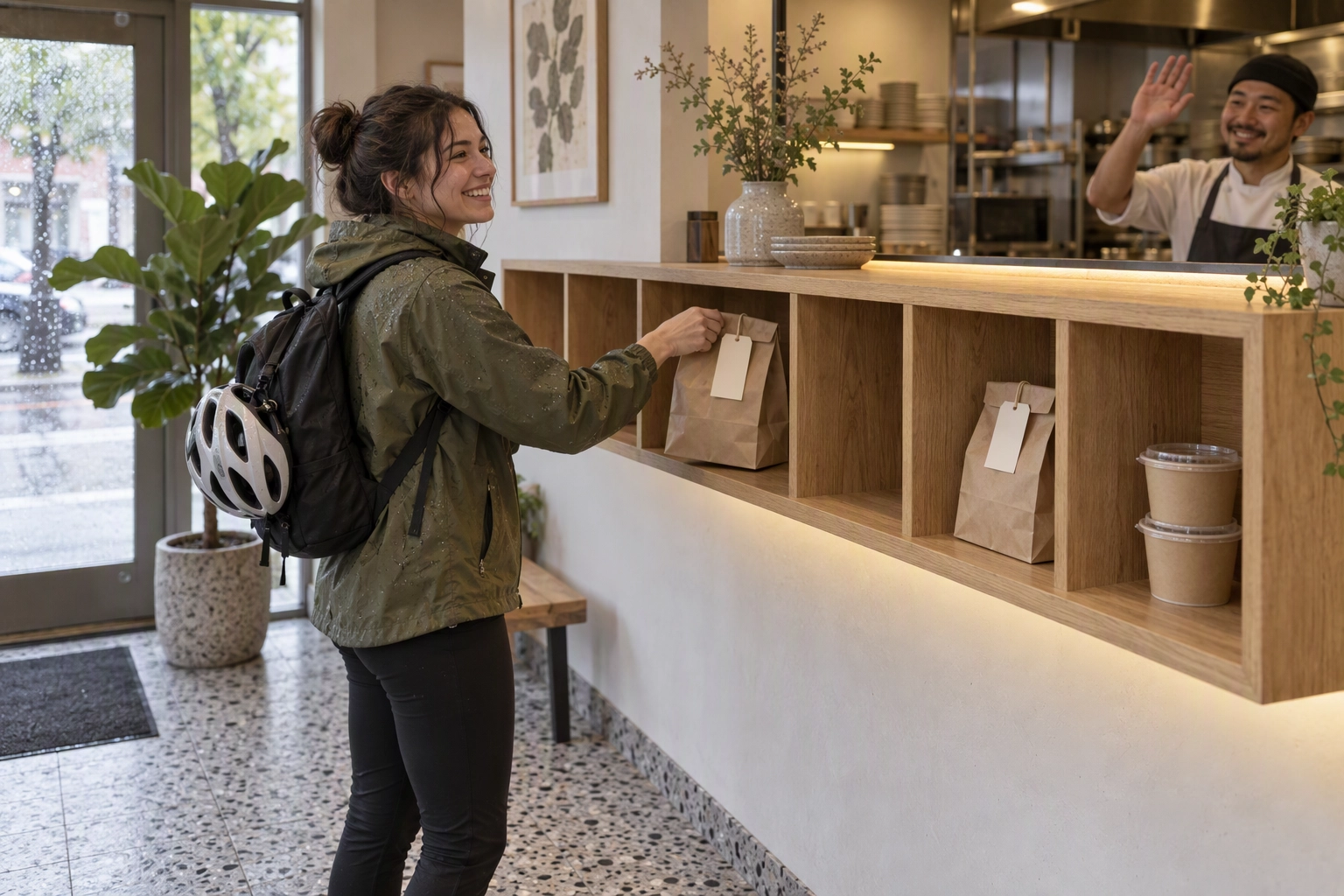 Regular customer collecting a direct online pickup order from an oak shelf by a restaurant door, keeping margin off the apps
Third-party apps find new customers; your own ordering page keeps the regulars' margin. A commission-free order link on your website, Google profile and Instagram bio costs little beyond card processing. Push repeat customers there with the bag card from tactic 8 and the same photos you use on the apps. The best restaurant websites show what a good order page looks like on a phone.
16. List on delivery apps with a welcome deal
Delivery apps increase restaurant sales by reaching customers who never search by restaurant name. DoorDash charges 15%, 25% or 30% on delivery depending on plan, and 6% on pickup. Price for the commission, list with photos from day one, and run one welcome deal: DoorDash says its promotions return a median $4 per $1 spent. Single-app depth: our DoorDash guide and Uber Eats playbook.
17. Sell gift cards all year, not just in December
Gift cards boost cash flow before the guest arrives, and often bring a new guest with them. Keep cards at the host stand, a buy link on your website, and a reason to buy outside the holidays: birthdays, teacher thank-yous. Gift card promotion ideas prices 20 offers; the December push sits in our separate holiday sales plan.
18. Post three real dishes a week on social media
Social media sells when it shows the dish someone will order tonight. Post three times a week, at least two of them close-ups of real plates, and pin a post with your order link. Show the cook, the pour and the plate, not your logo. Our Instagram routine fits it into 100 minutes a week, and a social media strategy keeps every post pointed at a sale.
19. Make your website answer three questions
Most first visits to a restaurant website ask three things: what's on offer, what it costs and how to order or book. Put the full list in text rather than a PDF, with prices and photos, and keep order and book buttons on the first phone screen. Text also helps local search, because Google can read it. Photo menus shows where pictures earn their space.
20. Turn tables faster at peak, without rushing anyone
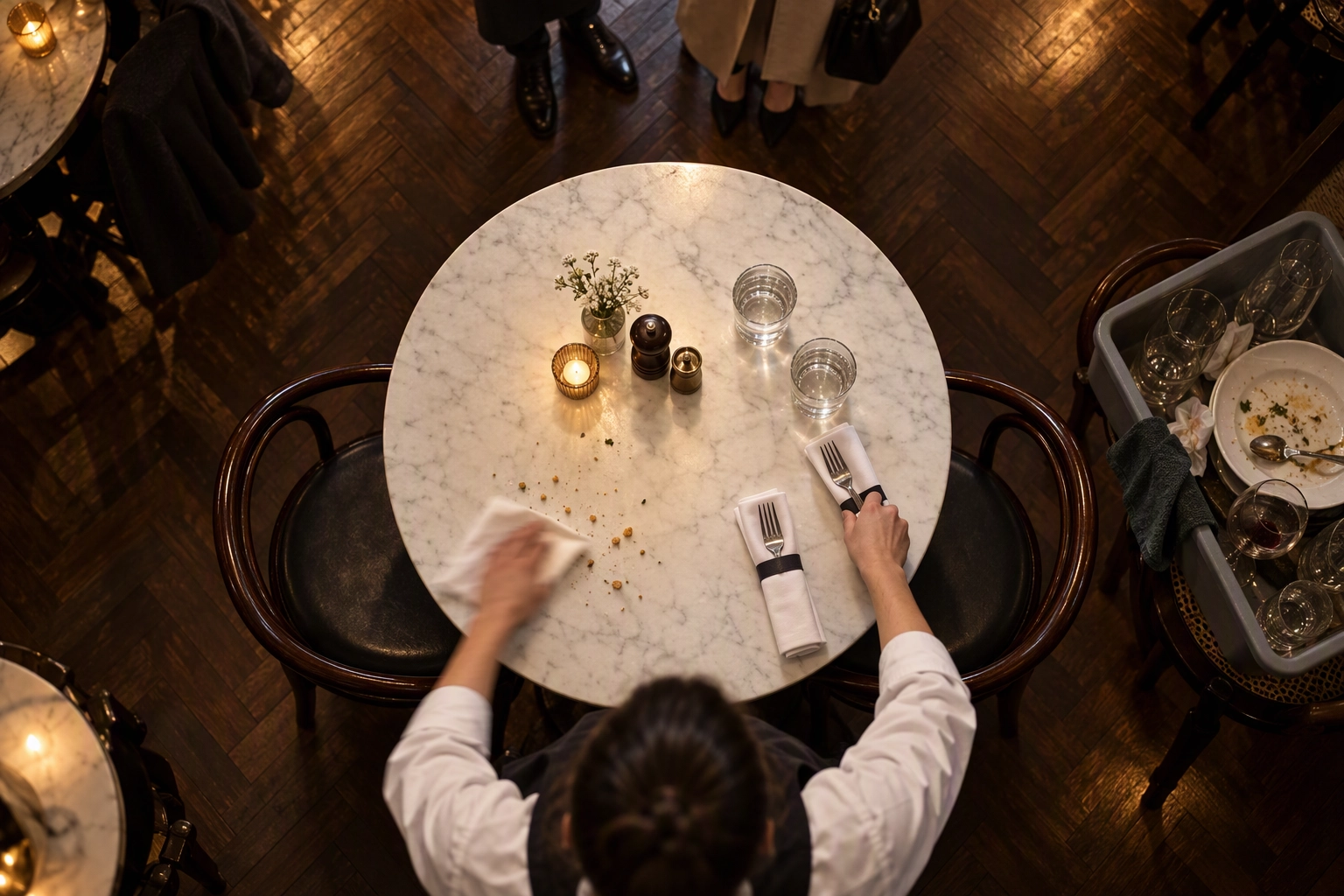 Overhead of a busser resetting a marble two-top during Saturday peak while the next party waits, a faster table turn
On full nights, seats cap sales, so minutes per table become the lever. Pre-bus continuously, drop the check when dessert is declined, and let people pay at the table. Handheld ordering costs more but cuts trips between table and terminal during peak service. Measure turn length before and after.
Big bets: 5 strategies that need cash or patience
Big bets can increase restaurant sales more than any quick win, but they need real money, new skills or a season to prove themselves. Most restaurants should start one only after the quick wins run themselves, give it a budget cap and a stop date, and judge it on margin, not on revenue alone.
21. Sell catering and office trays
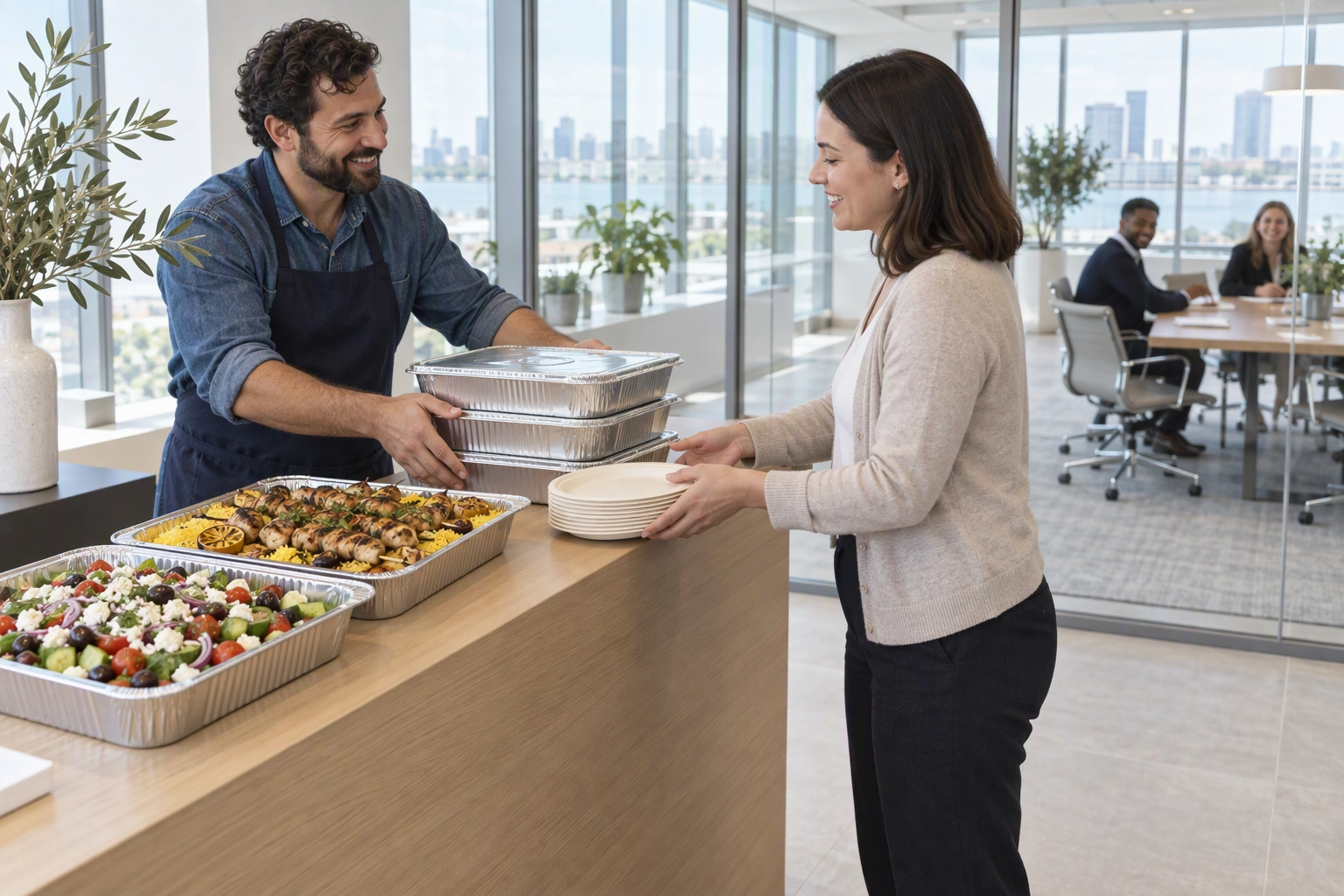 Restaurant owner handing office catering trays to an office manager at a reception desk, one order worth a dozen checks
Catering is the biggest-ticket way to increase restaurant sales without adding seats: one office order can equal a dozen dine-in checks. Build a five-item tray list from dishes that hold for an hour, photograph each tray from overhead, and email local office managers early in the week. How to grow catering sales covers eight levers, catering menu ideas prices 35 dishes per guest, and large DoorDash orders shows how $400 trays get booked through the apps.
22. Package private events and group dining
Groups bring predictable revenue: set menus, deposits and one bill. Create three packages at fixed prices per head, publish open dates on your website, and answer every inquiry the same day with a price attached. A group experience sells itself once the price is clear. Our restaurant event ideas lists 40 formats with cost and staffing for each.
23. Run paid local ads with a stop rule
Paid ads amplify what already converts; they don't fix a weak listing. Start at $5 to $30 a day, target a few miles around your door, and point every ad at one dish with a clear order or book button. Stop any campaign that can't show its cost per new customer after two weeks. Setups: Instagram ads, Facebook ads and Google Ads.
24. Invite local creators, not celebrities
A local creator with 5,000 to 20,000 engaged followers reaches your actual neighborhood; a celebrity mostly reaches people who will never visit. Comp the meal, agree in writing on one post and the paid-partnership disclosure, and give them a dish worth filming. Track a unique code to count the visits. Our food influencer guide has the outreach steps.
25. Sell what guests already ask to take home
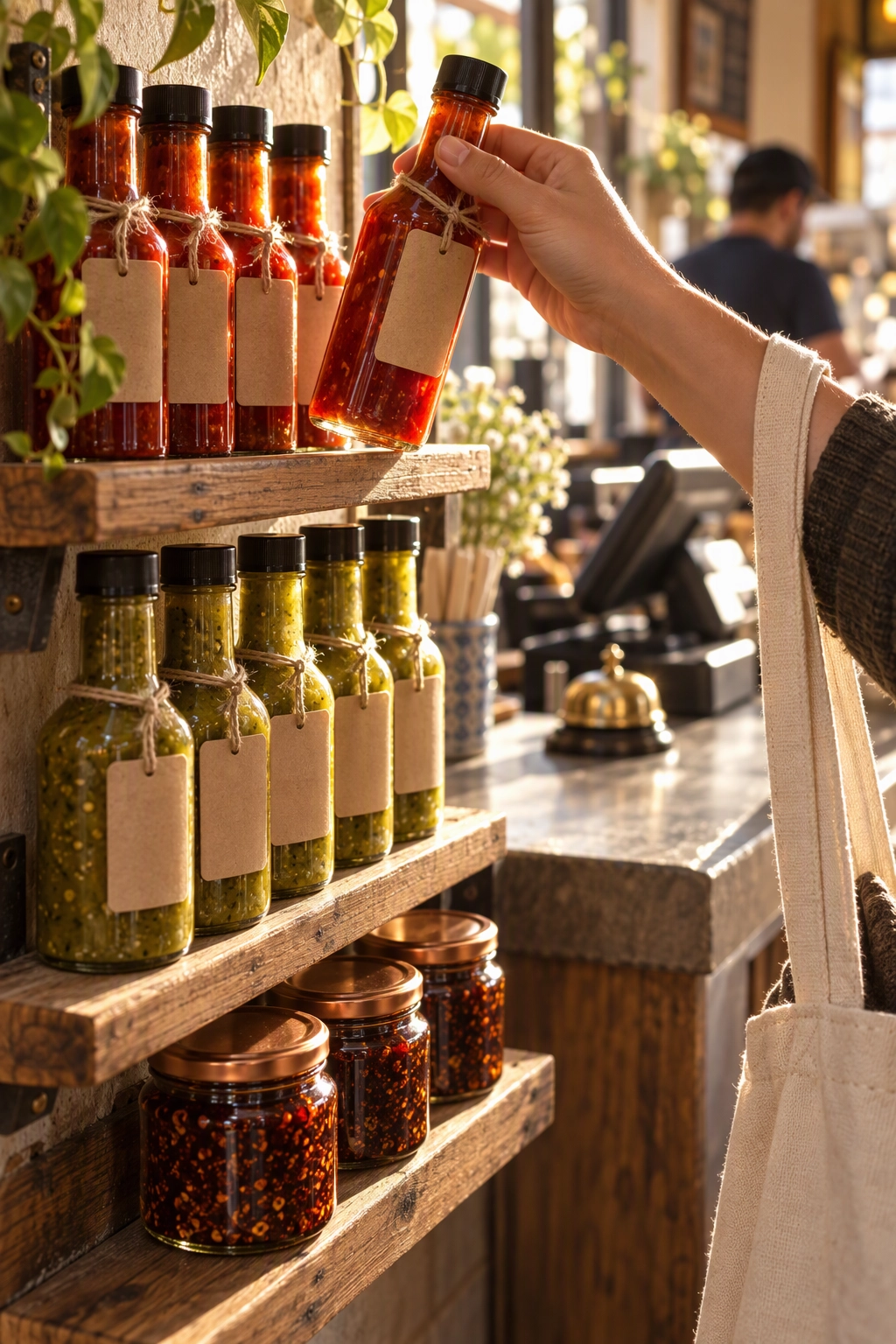 Customer taking a bottle of house hot sauce from a small retail shelf beside a restaurant register, a new revenue stream
If guests ask for your hot sauce, dressing or cold brew, bottle it, as many restaurants do. Start with one product at the counter and online, priced at three to four times its cost, and check your health department's rules for packaged goods before you sell. It's slow revenue, but it earns on days the dining room is empty. Sell online too, with packaged food photos of each bottle.
Which ways to increase restaurant sales should you skip?
Restaurants should skip any tactic that buys sales they'd have made anyway. Discounts on full nights, deep coupon deals and the top delivery tier bought without margin math all lift the top line while shrinking profit. So does a rebrand started before the eight quick wins are done: fix what customers see first.
- The top delivery tier without the math. At 30%, a $20 dish with $6 of ingredients leaves $8 before labor and packaging.
- A new logo before the basics. Fresh restaurant branding won't fix a bare listing or wrong hours.
Frequently Asked Questions
What is the cheapest way to increase restaurant sales?
An upsell script and a photo on every dish. Both cost close to nothing and can go live this week. They help the check and the conversion rate without a single new customer.
How long does it take to increase restaurant sales?
Upsells and add-ons show up on the next shift, listing fixes in one to two weeks, and loyalty, email and local search in one to three months. Compare each tactic against the same weeks last year, not last month, so seasonality doesn't fool you.
How can a small restaurant grow sales with no marketing budget?
Work rows 1 to 11 of the matrix, which all cost under $100. That covers upsells, bundles, photos, your Google profile, reviews, prices, menu engineering and slow sellers. Small restaurants can finish it in a month with the owner, the chef and one manager.
Should I raise prices or chase more customers?
Do both, in that order. Targeted price rises and menu engineering lift margin on every existing check, while new-customer tactics like ads take longer and cost more per sale. Once the check is healthy, every new guest you win is worth more to the business.