DoorDash vs Uber Eats vs Grubhub for Restaurants (2026)
 Ali Tanis18 min read
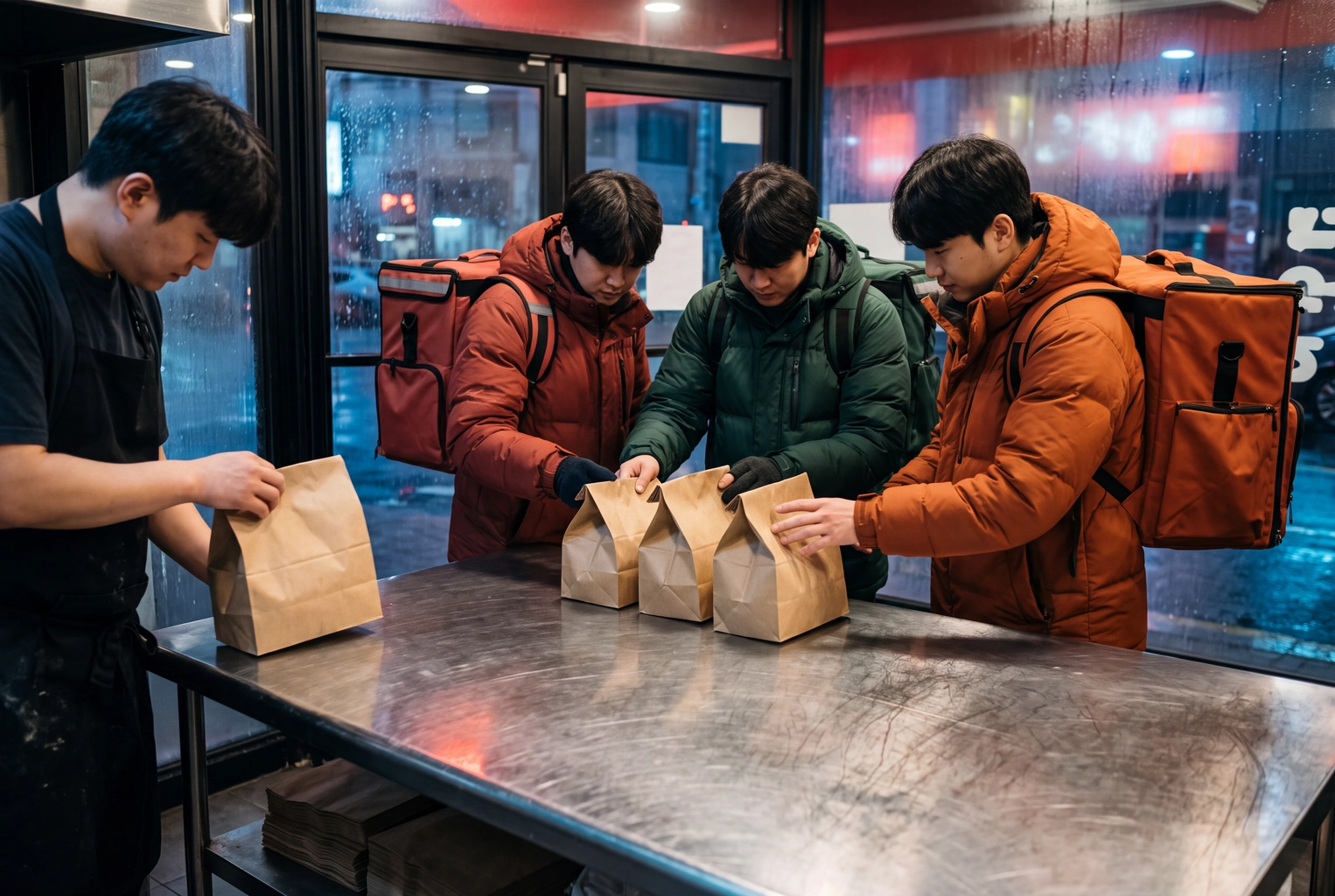
Choosing between DoorDash vs Uber Eats vs Grubhub as a restaurant comes down to three numbers: what each app keeps from an order, how many local customers it reaches, and how much work it adds behind the counter. Most comparisons answer for drivers or diners. This one is for the kitchen side, and every commission, payout rule and photo spec below was checked on each app's merchant pages on October 28, 2026.
Each app also crops dish photos to a different shape, so one picture can pass on one app and fail on the next. We show how one set of menu photos for delivery apps clears all three.
Quick Summary: For most US restaurants, DoorDash comes first: it held 60.7% of US food delivery sales at the end of 2024, and its 15% Basic plan is the cheapest way to get delivered orders. Uber Eats is the second app (or joint first in New York and Los Angeles, where the two are tied), and Grubhub earns its place through 5% self-delivery, catering and NYC. On one $30 delivered order you pay between $4.50 and $10.22, depending on the app and plan.
DoorDash vs Uber Eats vs Grubhub at a Glance (Rates Checked October 28, 2026)
DoorDash charges 15%, 25% or 30% per delivered order, Uber Eats 20%, 25% or 30%, and Grubhub 5%, 15% or 20% plus a delivery fee from 10% and card processing. Rates come from the DoorDash pricing page, the Uber Eats pricing page and Grubhub's pricing and fees page.
| Feature | DoorDash | Uber Eats | Grubhub |
|---|---|---|---|
| Delivery commission | 15% Basic, 25% Plus, 30% Premier | 20% Lite, 25% Plus (30% on Uber One orders), 30% Premium | 5% Basic, 15% Plus, 20% All-access, plus Grubhub Delivery from 10% |
| Pickup | 6% on every plan, with in-store price parity | 7% with validated in-store pricing | Marketing commission only |
| Card processing | Included | Included | 3.05% + $0.30 per order |
| Your own drivers | Not on the published plans | 15% self-delivery fee (25% when Uber couriers fill in) | No delivery fee |
| Intro rate | 0% for 7 days (Basic) or 30 days (Plus, Premier) | 0% for 30 days (Plus, Premium) | None published |
| Slow-month protection | Premier: commission refunded in months under 20 orders, first 6 months | Premium: fee reimbursed in months under 20 orders, first 6 months | None published |
| Member program | DashPass on Plus and Premier | Uber One on Premium, or +5% per member order on Plus | Grubhub+ on every plan |
| Ads and promos | Pay-per-order ads; promos add $0.99 per order | Ads on every plan; Premium matches up to $100 a month | Ad credit equal to your commission rate; promo credit up to $500 a month |
| Payout speed | Weekly; daily on request | Weekly; Daily Pay at $1 per location per day | Weekly, twice weekly or every two weeks |
| Order device | Tablet $6 a week after the trial; POS integrations free | Uber tablet (weekly fee varies) or the Orders app on your own device | Free welcome kit; POS and tech integrations |
| Menu item photo | 16:9, 1400 x 800 px minimum, under 2 MB | 5:4 to 6:4, 1200 x 800 px minimum, up to 10 MB | 1:1 square, 1400 x 1400 px recommended |
| Photoshoot offer | Free shoot of up to 20 items; Premier adds a $200 food credit | One free session for new US partners; Premium adds a $250+ photo package | Free professional menu photoshoot on every plan |
| Catering | Group Orders up to 15; Corporate Catering for 15 to 200+ | Large group orders 24 hours ahead, up to about 100 people | Catering for 10 to 200+, up to 14 days ahead |
| US share of delivery sales (end of 2024) | 60.7% | 26.1% | 6.3% |
DoorDash's plans apply to restaurants with 75 or fewer US locations; larger chains negotiate. New York City is the big exception: city law caps what apps can charge restaurants at 15% for delivery, 5% for basic service and 3% for transactions, with limited exceptions. NYC restaurants should read the NYC pricing pages.
Three traps the table hides
Grubhub's low headline rate stacks. The 5% Basic commission is real, but Grubhub-delivered orders add a delivery fee starting at 10%. Card processing then adds 3.05% plus $0.30, a charge Grubhub's fee FAQ itemizes on its own. A "5%" delivered order lands near 19% all-in.
Uber Eats changed its tiers on March 11, 2026. Per Uber's fee-change notice, Lite rose from 15% to 20%, and Plus now charges 30% on Uber One member orders. Restaurant Dive reported that Lite stores only appear when a customer searches by name.
Cheap pickup rates come with a price rule. DoorDash's 6% pickup requires your app prices to match in-store prices. Uber's 7% needs validated in-store pricing. If you mark up app prices, expect to pay more on pickup.
What Does Each App Keep From a $30 Order?
On a $30 delivered order, DoorDash keeps $4.50 to $9.00, Uber Eats $6.00 to $9.00, and Grubhub $5.72 to $10.22 once its delivery fee and card processing are added. Each step up buys features: a bigger delivery radius, lower customer delivery fees, or member access.
| Plan level | DoorDash | Uber Eats | Grubhub (with Grubhub Delivery) |
|---|---|---|---|
| Entry | Basic: $4.50 (15%) | Lite: $6.00 (20%) | Basic: $5.72 (5% + 10% + $1.22) |
| Middle | Plus: $7.50 (25%) | Plus: $7.50, or $9.00 on an Uber One order | Plus: $8.72 (15% + 10% + $1.22) |
| Top | Premier: $9.00 (30%) | Premium: $9.00 (30%) | All-access: $10.22 (20% + 10% + $1.22) |
| $30 pickup order | $1.80 (6%) | $2.10 (7%) | Basic: $2.72 (5% + $1.22) |
The $1.22 is Grubhub's processing on $30 (3.05% is $0.92, plus $0.30). We worked it on the subtotal; if your statement applies it to tax and tip too, it runs a few cents higher.
Promotions, ads and a tablet come on top: our breakdown of DoorDash fees for restaurants shows how a $5-off promo pushes the same $30 order past 32% on every DoorDash plan.
A 20-Order Day Through Each App
A day of 20 orders at $30 each, 16 delivered and 4 picked up, gives $600 in sales. On entry plans, DoorDash takes $79.20, Grubhub $102.40 and Uber Eats $104.40. On the highest plans the range is $151.20 to $192.40.
| Plan level | DoorDash | Uber Eats | Grubhub |
|---|---|---|---|
| Entry (Basic, Lite, Basic) | $79.20 | $104.40 | $102.40 |
| Middle (Plus, Plus, Plus) | $127.20 | $128.40 + $1.50 per Uber One order | $162.40 |
| Top (Premier, Premium, All-access) | $151.20 | $152.40 | $192.40 |
| Entry tier over a 30-day month | $2,376 | $3,132 | $3,072 |
| Top tier over a 30-day month | $4,536 | $4,572 | $5,772 |
How the entry row of this worked example adds up: DoorDash is 16 x $4.50 plus 4 x $1.80. Uber Eats is 16 x $6.00 plus 4 x $2.10. Grubhub is 16 x $5.72 plus 4 x $2.72.
The insight most fee comparisons miss: the fee gap between the cheapest and dearest app is about $25 a day at the entry tier and $41 at the top. The reach gap is far bigger: DoorDash's share of US delivery spend was more than twice Uber Eats' and almost ten times Grubhub's at the end of 2024. So pick the app your customers already use, then the cheapest plan that still shows you to them.
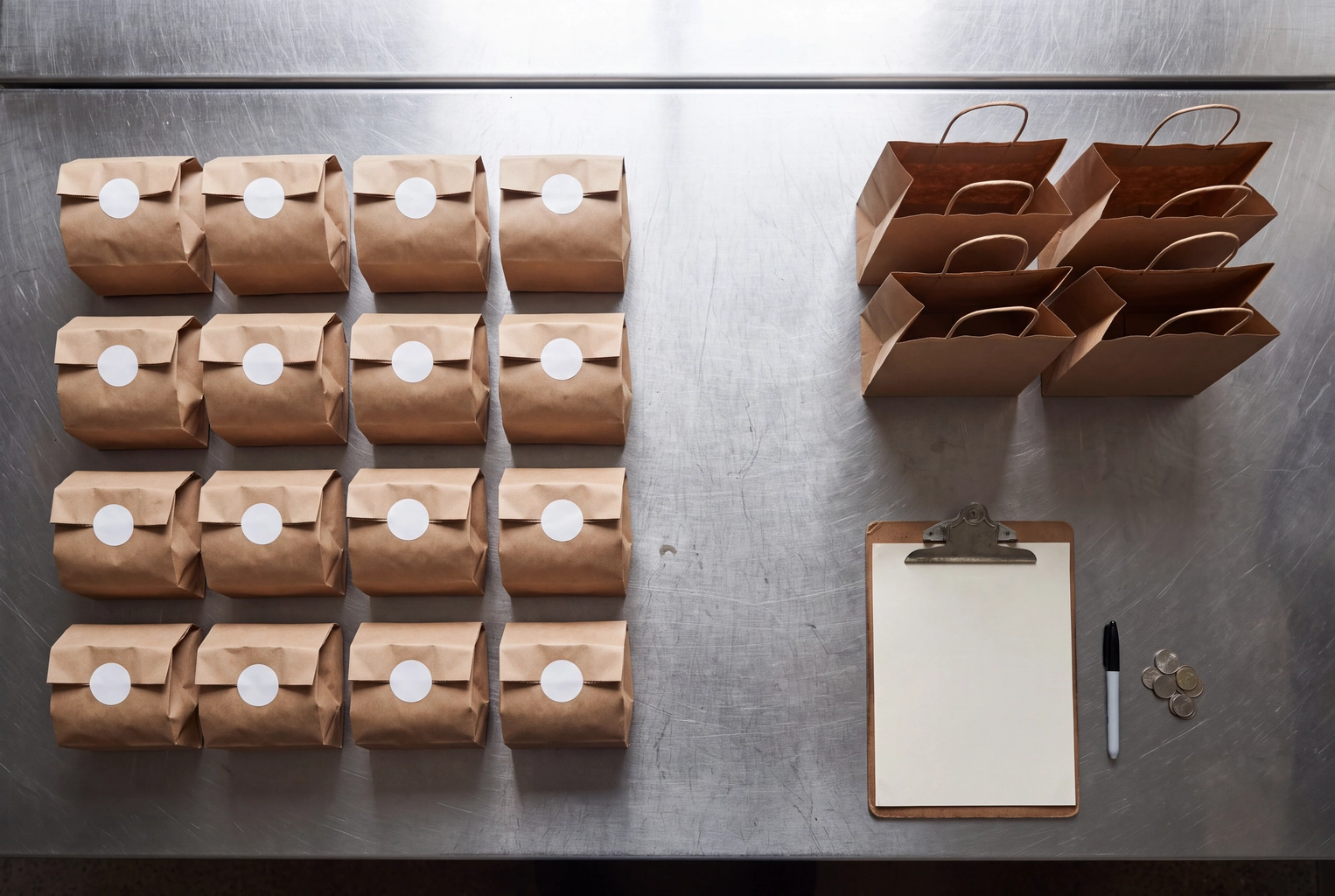 Rows of sealed kraft delivery bags beside handled pickup bags and a blank clipboard on a steel prep table, a 20-order day on delivery apps
Which App Has the Most Customers Near You?
Nationally, DoorDash has the most customers: Earnest Analytics card data put it at 60.7% of US food delivery sales at the end of 2024, against 26.1% for Uber Eats and 6.3% for Grubhub. Big cities are closer. In the New York area DoorDash held 38.4%, Uber Eats 38.2% and Grubhub 17.6%.
Los Angeles is a dead heat too: Uber Eats 41.9%, DoorDash 41.8%, Grubhub 11.0%. If you cook in either city, Uber Eats is not a second-tier app.
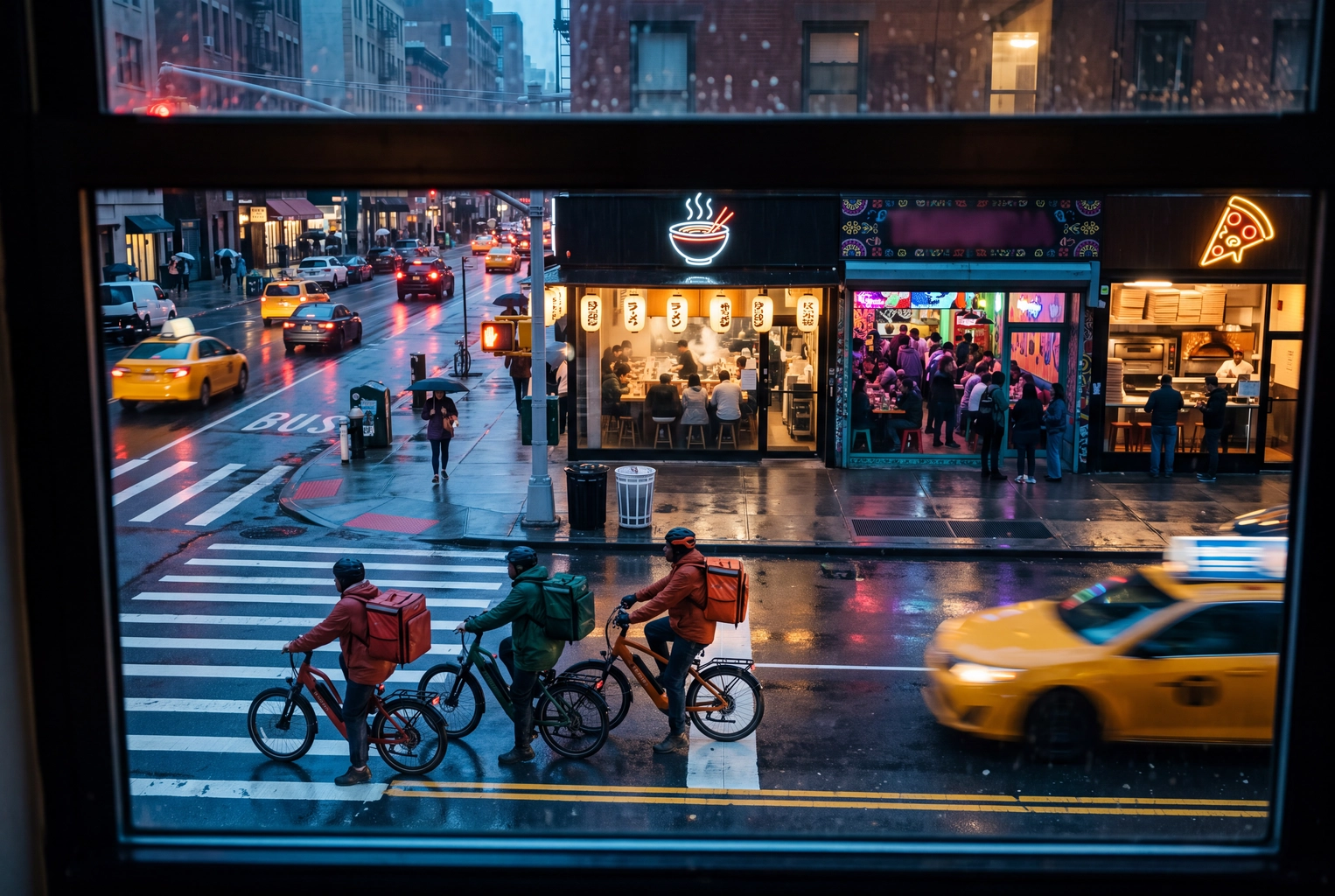 Delivery cyclists in red, green and orange rain jackets at a busy New York crosswalk at dusk, where delivery app market share is close
A second insight: loyalty matters as much as share. Earnest found that 47% of DoorDash customers return long-term, against 29% for Uber Eats and 11% for Grubhub. A first order on DoorDash is more likely to become a regular.
Each app also runs a subscription with member rewards that steers its most frequent users:
- DashPass (DoorDash): included on Plus and Premier, so Basic stores miss these users.
- Uber One: Uber says members order 2x more than non-members. The same subscription covers rides and grocery delivery, so users have more reasons to stay.
- Grubhub+: $0 delivery fees for members on every plan, and free for Amazon Prime members. Grubhub says its members order 4x a month, almost 70% more often than non-members.
Grubhub is now owned by Wonder, which bought it for $650 million, as TechCrunch reported in November 2024.
National numbers only go so far, so check your own zip code. Open each app as a customer at 7 pm on a Friday, for example, and count the restaurants in your category. Then ask regulars which app is on their phone.
Tablets, POS and Payouts: The Day-to-Day Effort
DoorDash integrates with your POS for free, Uber Eats needs no extra hardware, and Grubhub pays out no faster than twice a week.
- DoorDash: the tablet costs $6 a week in the US after the trial, and point-of-sale integrations are free. Payouts arrive weekly by default; you can switch to daily payouts in the Merchant Portal.
- Uber Eats: a rented tablet carries a weekly subscription that varies by connection type, or you run the Uber Eats Orders app on any device in Chrome. Payments land weekly by direct deposit, or daily through Daily Pay at $1 per location per day, limited to select stores.
- Grubhub: a free welcome kit plus POS and tech integrations. Direct deposit runs weekly, twice a week or every two weeks, and checks arrive monthly.
The real effort cost is the counter. Three tablets chiming at once is how orders get missed, and every app ranks you lower when you cancel or go offline. Push all three into your POS or one ordering hub in your tech stack before adding the third.
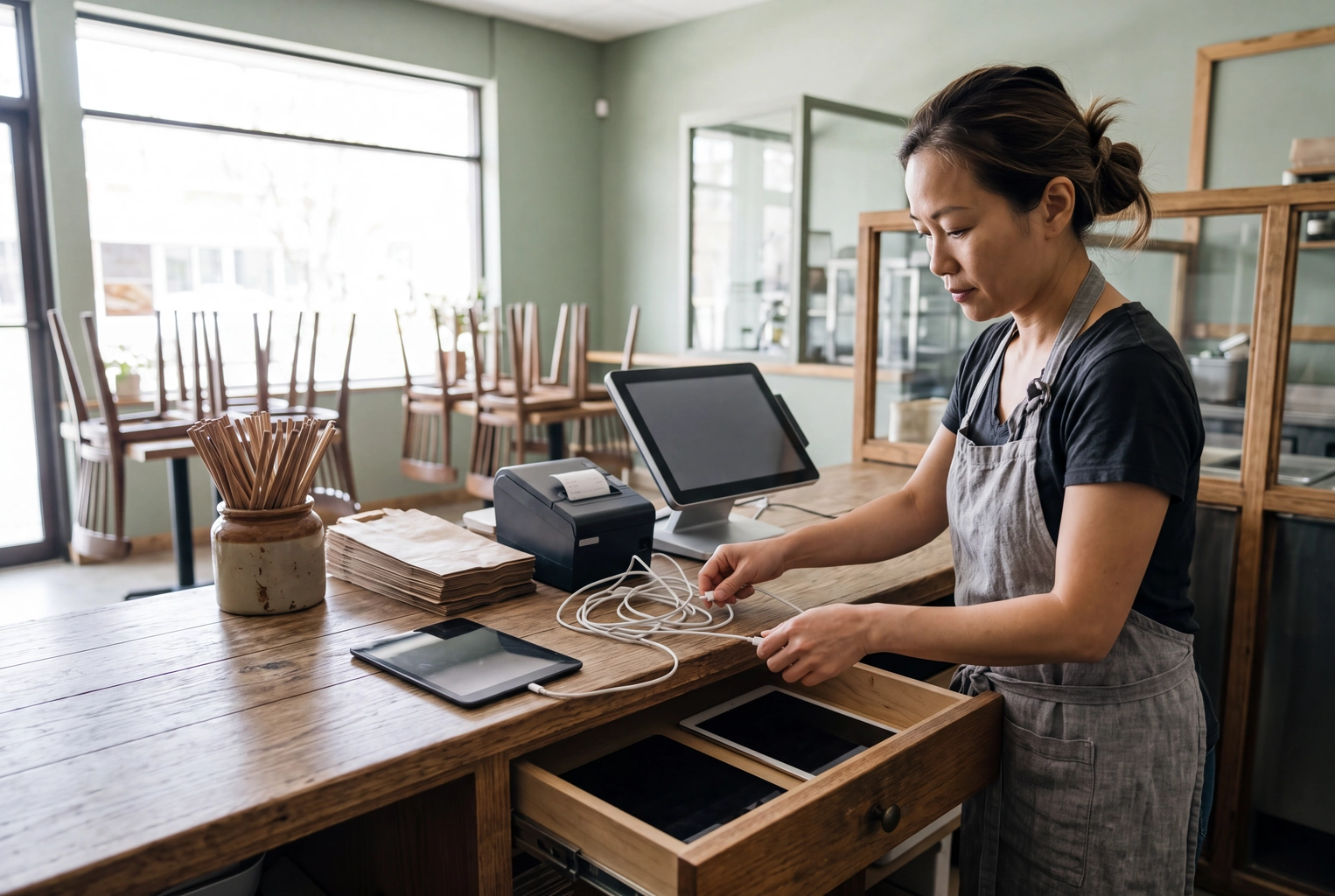 Restaurant manager unplugging two spare order tablets with dark screens before service to run every delivery app through one POS
Ads, Promotions and Perks Compared
Grubhub offers the largest published marketing credits, DoorDash bundles ads into Premier, and Uber Eats matches up to $100 of ad spend a month on Premium.
- DoorDash: ads are pay-per-order, not pay-per-click. Promotions cost the customer discount plus a flat $0.99 marketing fee per order. Premier runs automatic ads at no extra cost.
- Uber Eats: any plan can buy ads and offers. Premium matches last month's ad spend with up to $100 in credit, plus a free year of Uber One.
- Grubhub: every plan includes an ad credit equal to your commission rate and up to $500 a month in promo credit. The fine print limits the ad credit to qualifying small and mid-size merchants.
Free perks and rewards only pay off if the listing converts the extra views. Our guides on how to get more orders on Uber Eats and more orders on DoorDash cover the fixes worth making before you spend a dollar on ads.
Menu Photo Rules and Free Photoshoot Offers by App
The three apps want three different shapes: DoorDash takes landscape 16:9, Uber Eats 5:4 to 6:4, and Grubhub a 1:1 square. Upload one crop everywhere and at least one app will reject it or cut the dish in half. DoorDash's 2026 Restaurant Industry Trends Report puts the sales lift at 13% when photos cover more than half a menu.
| Rule | DoorDash | Uber Eats | Grubhub |
|---|---|---|---|
| Item photo shape | Landscape 16:9 only | 5:4 to 6:4 | 1:1 square |
| Minimum size | 1400 x 800 px | 1200 x 800 px | 1400 x 1400 px recommended |
| File | JPG or PNG, under 2 MB | JPG, PNG or GIF, up to 10 MB | JPEG preferred, PNG accepted |
| Free shoot | Up to 20 items, if a photographer serves your area | One session for new US partners | Every plan |
| Catch | Photos can't be used on other delivery apps | No published dish count | Covers today's menu; new dishes are on you |
Full specs live in our DoorDash photo requirements, Uber Eats photo requirements and Grubhub photo requirements guides.
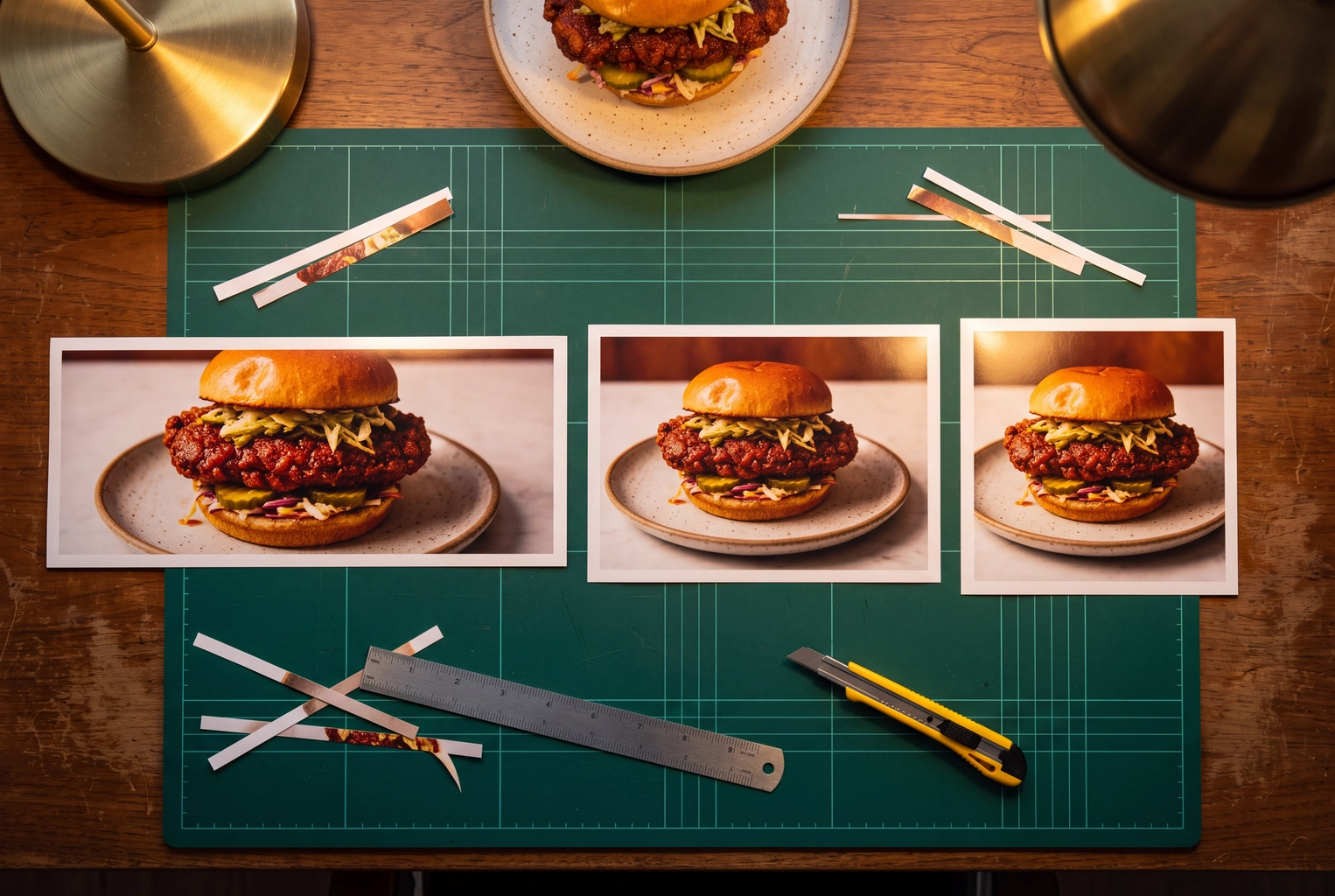 Three prints of one hot chicken sandwich trimmed to a wide 16:9 landscape, a 5:4 landscape and a square, one photo cropped for each delivery app
Book the free shoots, but compare their features first. The free DoorDash photoshoot covers up to 20 dishes, and Premier adds a $200 credit for food and styling, yet those photos are barred from other delivery platforms. The Uber Eats photoshoot is one session with no published dish count. Our Grubhub photoshoot guide covers the third.
None of the three shoots covers next month's special. The practical fix is one master photo per dish, cropped three ways. For example, shoot a burger from a phone, centred, with room on every side. A 2048 px wide 4:3 frame clears every minimum after cropping: 2048 x 1152 for DoorDash, 1920 x 1536 for Uber Eats, and 1536 x 1536 for Grubhub.
FoodShot is built for that step. It turns the phone shot of your real dish into a studio-style 2K photo in about a minute, from 200+ styles. Plans start at $15 for 25 photos a month, each with a commercial license, so one dish set covers all three apps. The apps still require the photo to show the actual item, which is why it restyles your own shot. Our guide to the AI edits the apps accept shows where the line sits.
Catering and Large Orders: Which App Handles Trays?
All three apps take large orders, but Grubhub and DoorDash run full catering flows: Grubhub for 10 to 200+ people scheduled up to 14 days ahead, and DoorDash's Corporate Catering for 15 to 200+. Uber Eats handles large group orders today and has agreed to buy ezCater, the largest online catering service in the US.
- DoorDash: group ordering features suit teams of up to 15, and Corporate Catering handles planned events. Our guide to large orders on DoorDash covers the tray menu.
- Uber Eats: customers should schedule large group orders 24 hours ahead, with about 100 participants as the suggested ceiling. On October 6, 2026, Uber announced a $2.3 billion deal for ezCater, whose average order tops $400, per Nation's Restaurant News.
- Grubhub: restaurants set their own notice window, up to 24 hours, per Grubhub's catering FAQ. Corporate accounts order through Grubhub for Business.
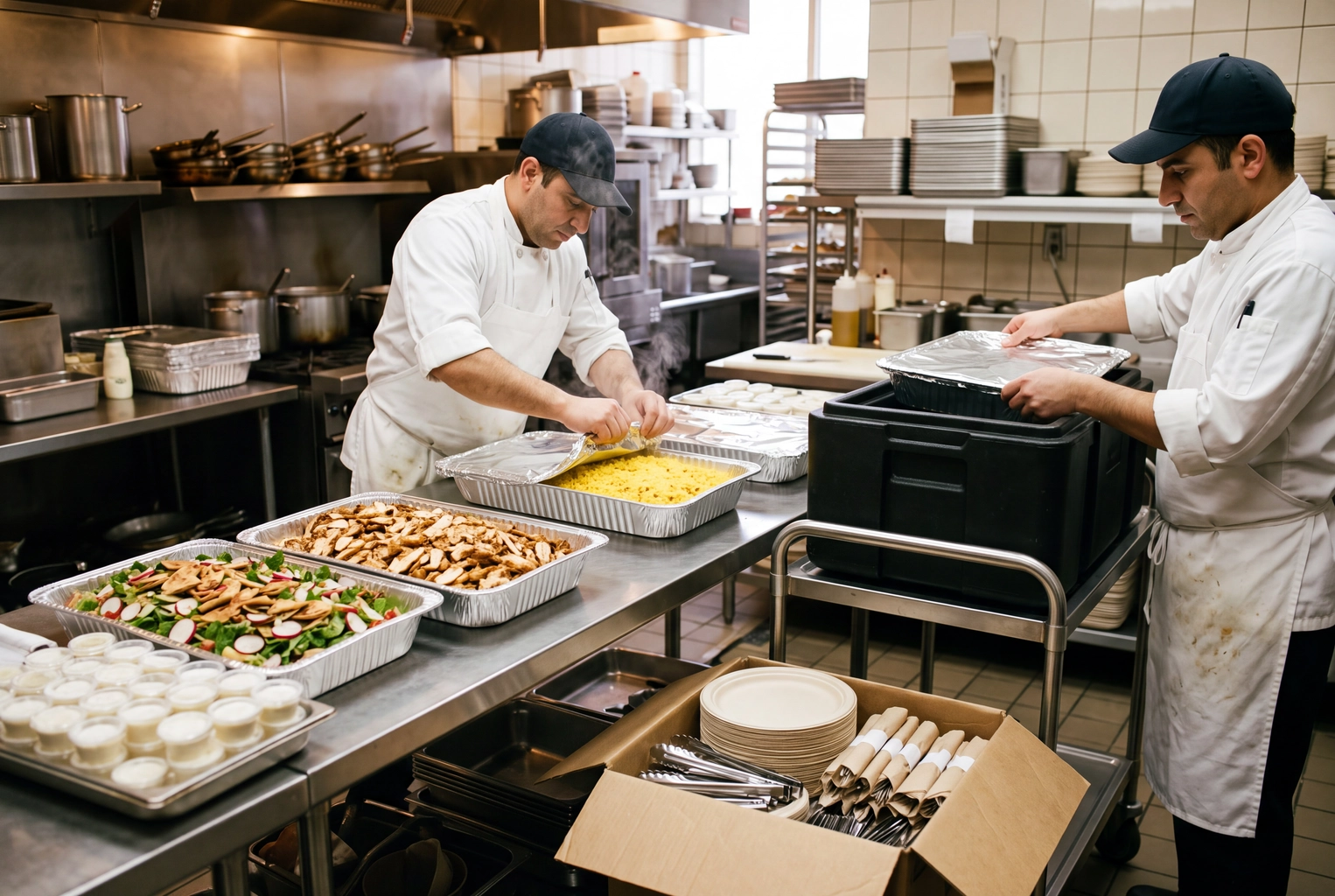 Cooks sealing hotel pans of chicken shawarma, rice and fattoush into an insulated carrier for a scheduled 40-person catering order
Fees decide catering. Take a $400 tray as an example: it costs $60 on DoorDash Basic and $80 on Uber Eats Lite. On Grubhub Basic with your own driver, it costs $32.50 (5% plus processing). If you already deliver catering yourself, Grubhub is the cheapest app you can add.
Which Delivery App Should Your Restaurant Join First?
Most restaurants should join DoorDash first because it reaches the most customers. The exceptions are fine dining, where Uber Eats Lite fits guests who search by name, and catering, where Grubhub's 5% self-delivery rate wins. Use this decision matrix by restaurant type.
| Restaurant type | Join first | Start on | Add second | Why |
|---|---|---|---|---|
| QSR / fast casual | DoorDash | Plus | Uber Eats Plus | Low tickets need $0-delivery-fee members to convert; 6% pickup covers counter regulars |
| Ghost kitchen | DoorDash | Premier, first 6 months | Uber Eats Premium | No walk-in traffic, so you live on placement; both high tiers refund fees in slow months |
| Fine dining | Uber Eats | Lite, or pickup only | DoorDash pickup at 6% | Guests already search you by name; 30% of a $120 order is $36 |
| Cafe / bakery | DoorDash | Basic | Uber Eats, only in dense downtowns | Small tickets and morning pickup; 6% pickup is the cheapest channel |
| Catering | Grubhub | Basic with self-delivery | DoorDash Corporate Catering | $32.50 on a $400 tray against $60 on DoorDash Basic; 14-day scheduling |
A ghost kitchen on DoorDash is the clearest case for paying the highest tier, since both Premier and Premium protect a slow launch. Ghost kitchens, fine dining rooms and cafes each have their own photo needs too.
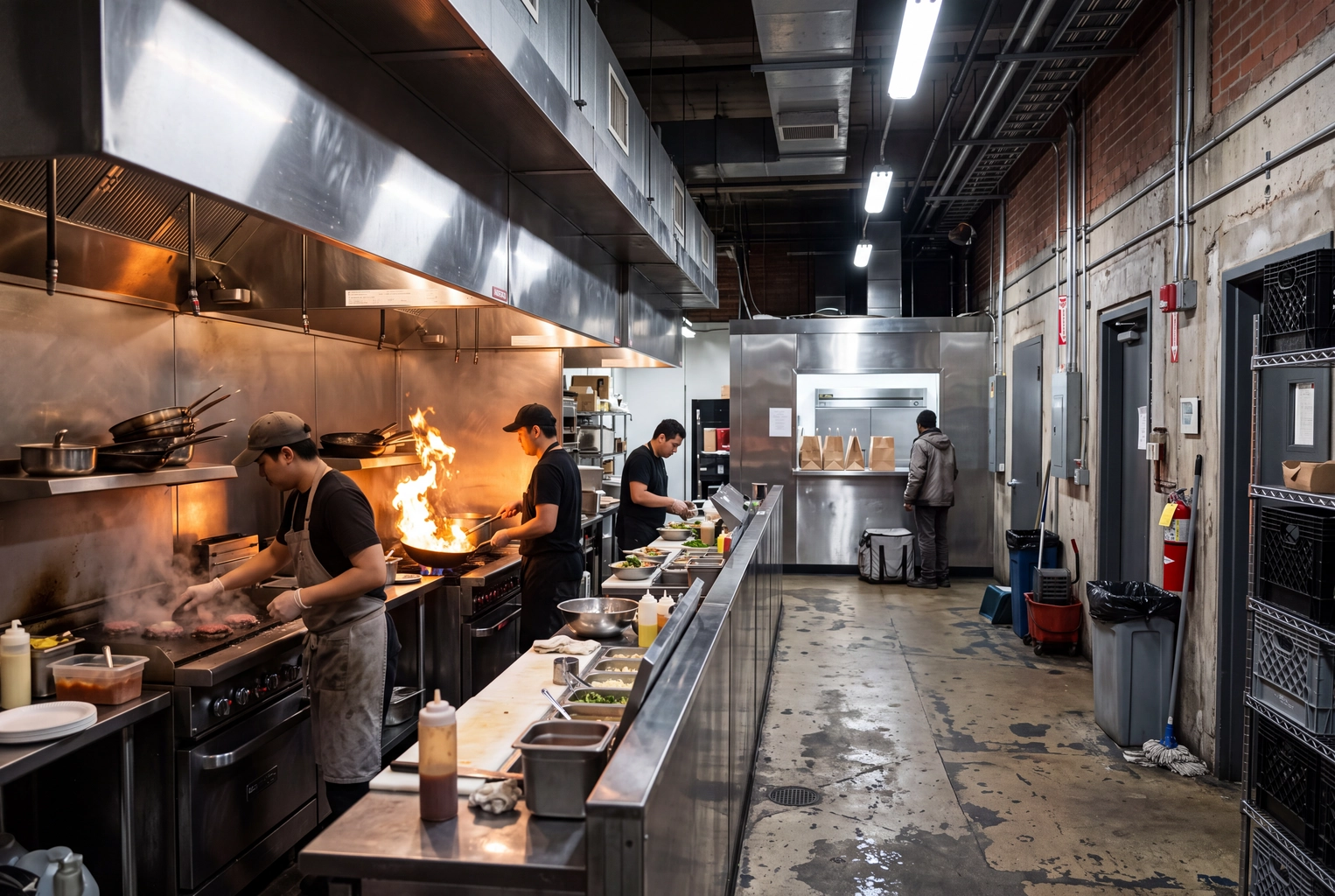 Delivery-only ghost kitchen corridor with cooks at separate stations and a courier at the pickup window, the case for a top delivery app plan
Should You Drop One of the Three Apps?
Drop an app when its upkeep or its effect on ratings outweighs the orders it brings, not just because volume is low. None of the three charges a monthly fee, so a quiet app costs little. Downgrade the plan first, and drop the app only if it fails a 30-day testing window.
Run the test with numbers from each merchant portal:
- Orders per app. Under 20 orders a month, tablet and menu upkeep may cost more than the margin.
- Real cost per order. Add commission, promos, ads and tablet fees, divide by orders, and compare with your menu pricing margin.
- Errors and ratings. Missed orders on a third tablet drag down your customer service scores.
- New versus repeat guests. If an app mostly sends regulars, move them to direct online ordering.
Grubhub lists no platform or maintenance fees, so it costs little while quiet; DoorDash's tablet runs $6 a week regardless. Before testing a cut, read how to increase restaurant delivery sales.
Frequently Asked Questions
Which delivery app takes the lowest commission from restaurants?
Grubhub's Basic plan has the lowest headline rate at 5%, but delivered orders add at least 10% plus 3.05% and $0.30 for processing. With delivery included, DoorDash Basic is the cheapest at 15%. For pickup, DoorDash's 6% is the lowest when app prices match in-store prices.
Is it worth listing on DoorDash, Uber Eats and Grubhub at the same time?
Two apps are worth it for most restaurants; the third only if it reaches a different crowd, as Grubhub does in New York and in catering. With no monthly fees, a third listing costs a tablet, menu syncing and missed orders, so integrate first.
Which delivery app pays restaurants fastest?
DoorDash and Uber Eats both offer daily payouts: DoorDash through a Merchant Portal setting, Uber Eats through Daily Pay at $1 per location per day at select stores. Grubhub's fastest option is a direct deposit twice a week.
Can I charge higher menu prices on delivery apps?
Usually yes for delivery, but price parity unlocks the cheapest pickup rates. DoorDash's 6% pickup requires app prices to match in-store, and Uber's 7% needs validated in-store pricing. If you mark up the delivery menu, check what it does to order volume over a full month.
Do I need different menu photos for each delivery app?
You need different crops, not different photos. DoorDash takes 16:9 landscape, Uber Eats 5:4 to 6:4, and Grubhub a 1:1 square. Shoot one centred master per dish, then export three crops; a 2048 px wide 4:3 frame clears all three minimums.
Is Grubhub still worth it for restaurants in 2026?
Yes, in the right niche. Its national share was 6.3% at the end of 2024, but 17.6% in the New York area. It also offers 5% self-delivery, a free photoshoot on every plan, and Grubhub+ free for Amazon Prime members. Outside New York, treat it as your third app.